
A/C + solar panels: why summer is the perfect scenario for self-consumption
The A/C kicks in at 3pm and the panels are at peak production. That coincidence makes summer the best case for self-consumption, especially with VAT back at 21 %.
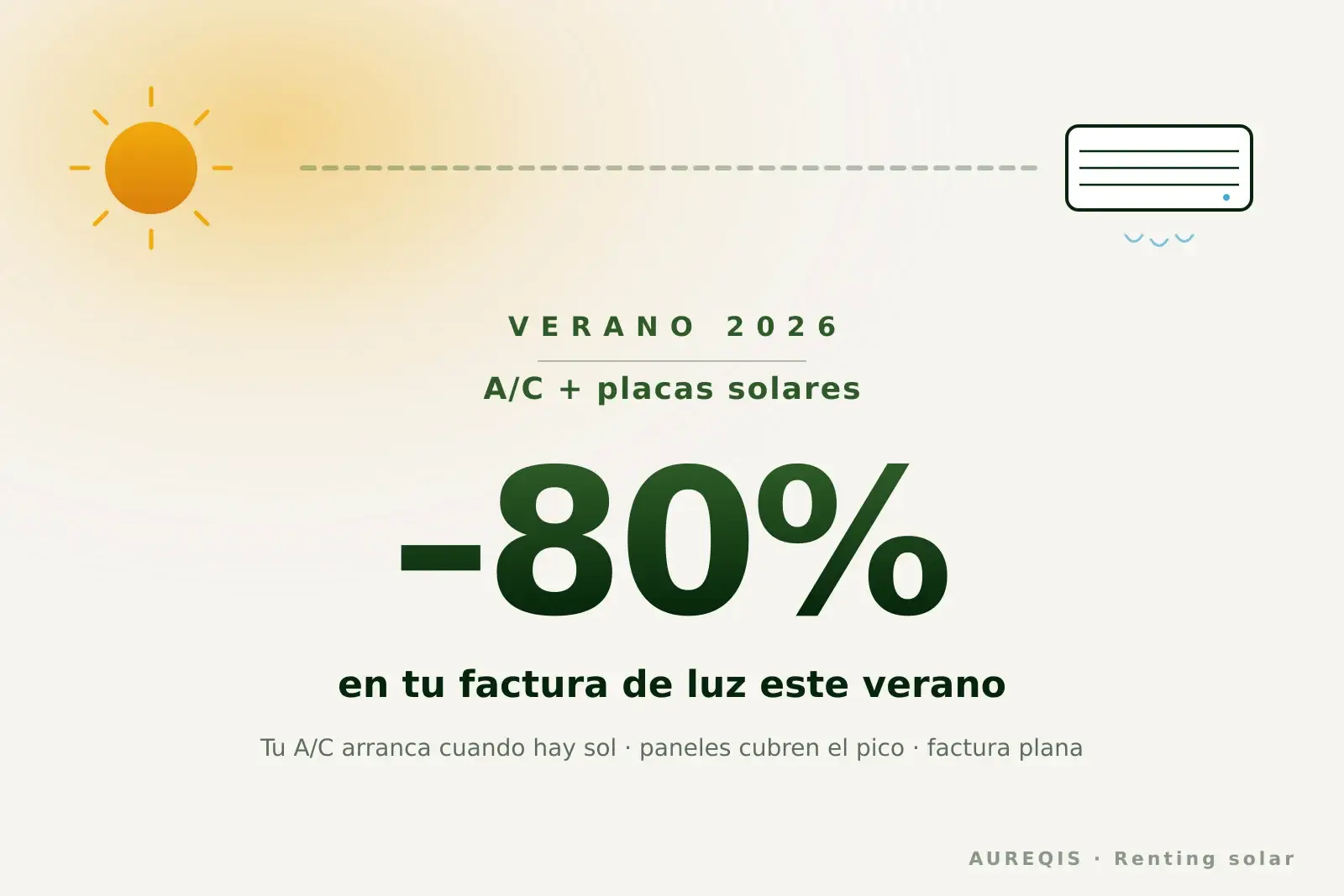
Today, June 21st, is the summer solstice in Spain: the longest day of the year, with nearly 15 hours of sunlight over the peninsula. From tomorrow onward the days start —by millimetres— to shorten, but the thermal reality is the opposite: July and August are the months with the highest effective radiation, the highest ambient temperature and the highest electricity consumption of the year in any Spanish home or business.
And here happens the most beautiful coincidence of solar self-consumption: the moment you crank the air conditioning to the max —between 2pm and 8pm— is exactly the same moment your panels are injecting their maximum production. That correlation isn’t marketing; it’s pure solar geometry. And with VAT on electricity back to 21 % since June, every kWh you save in those hours is worth considerably more than three months ago.
The Spanish summer: the perfect storm of consumption
For a typical home in the southern half of the peninsula, the annual electricity consumption split is brutally concentrated:
| Month | % of annual consumption | Main driver |
|---|---|---|
| January–February | ~22 % | Electric heating + DHW |
| March–May | ~18 % | Base + DHW |
| June–September | ~42 % | Air conditioning + pool pump |
| October–December | ~18 % | Base + DHW |
Almost half of your annual bill is concentrated in four months. And within those months, air conditioning represents 55-70 % of household consumption. A 3,500-frigorie Inverter unit (3.5 kW cooling, ~1.1 kW electrical) running 6 hours a day during July and August consumes around 200 kWh/month just for climate control. Multiply by two splits in a medium house and you’re at 400-450 kWh extra for each of those two months that you didn’t have in May.
At €0.18/kWh PVPC during peak evening hours with 21 % VAT and all taxes, that’s €80-90 of additional monthly cost appearing on your July and August bill without you changing anything in your life. For many households it’s the difference between a comfortable bill and one that hurts.
The solar-A/C correlation: why they fit so well
Air conditioning has a usage pattern very concentrated in midday and afternoon bands: you start it around 2pm when the house begins to heat up, real peak between 4pm and 8pm, and many households keep at least one split on until late at night.
A residential solar installation in Spain produces, in July:
| Solar hour | Typical production (% of peak) |
|---|---|
| 8:00 | 15 % |
| 11:00 | 70 % |
| 14:00 | 95 % |
| 16:00 | 90 % |
| 18:00 | 65 % |
| 20:00 | 25 % |
| 21:30 | 5 % |
The overlap is almost perfect. When the A/C demands 1.1 kW constantly for six hours straight, the 3.5 kWp on the roof are giving you between 2.5 and 3.3 kW during five of those six hours. Result: the air conditioning supplies itself from the sun, and you still have leftover production for the fridge, a washing machine scheduled at noon, the pool pump, and electric car charging if you have one.
In winter the correlation is the opposite: maximum consumption at 8am and 9pm, almost no solar production at those hours. That’s why, residentially, summer is where direct self-consumption has the strongest physical fit. Any kWh consumed between 11am and 7pm in July-August is free if you have panels.
Real numbers: typical home with A/C in summer
Let’s take a 110 m² home in climate zone C (peninsular interior), 2.5 kW contracted power, 4,200 kWh/year, with two Inverter splits running ~6 h/day between June 15th and September 15th.
Without solar (summer 2026, VAT 21 %)
- July consumption: 520 kWh (300 base + 220 A/C)
- August consumption: 540 kWh (300 base + 240 A/C)
- July + August cost: ~€220
- Rest-of-year cost: ~€520
- Annual total: ~€740
With 3.5 kWp solar in direct self-consumption + surplus compensation
- Annual production: ~5,800 kWh
- Direct self-consumption (much higher in summer thanks to the A/C correlation): ~3,500 kWh → 60 % of total consumption covered in-house
- Surplus compensated on the bill: ~€900 in annual balance at average pool price
- Net annual electricity bill: ~€130-180
- Net savings: ~€560-610/year
And what’s interesting: the bulk of those savings concentrates in July and August, exactly when the no-solar bill was at its highest. The monthly bill amplitude flattens — you go from oscillating between €35 and €110 to oscillating between €12 and €25. Financial predictability, not just savings.
What about the pool pump?
If you have a pool, the filter pump is an almost ideal use case for self-consumption. A 0.75 kW pump running 8 h/day in summer consumes ~180 kWh/month. Scheduled between 11am and 7pm, that consumption is fully absorbed by the solar production of a standard residential installation. The pool’s electricity cost approaches zero during intensive-use months.
The same applies to:
- Electric DHW tank: if you schedule it to heat between noon and 4pm, you remove another 80-120 kWh/month from the bill.
- Washing machine and dishwasher: start them with a timer at midday, not at night.
- Electric car charging: if you work from home or the car is parked during the week, charging it from the sun turns 100 % of your mobility cost into self-produced solar energy.
The trick isn’t to consume less: it’s to shift consumption within the day so it coincides with production.
The 2026 fiscal detail that changes the math
Until May 31st 2026 the VAT on electricity was at 10 % and the Special Electricity Tax at 0.5 %. Since June 1st both have gone back to their general rates: 21 % and 5.11 % respectively. For a household without solar this makes the summer bill ~15 % more expensive. For a household with solar, the opposite happens: every kWh you produce and consume yourself escapes both taxes, and therefore the relative saving from self-consumption grows.
In numbers: the payback of a 3.5 kWp residential installation in climate zone C, which in 2024 with VAT at 10 % was around 7.5 years, drops to 5.5-6 years with VAT at 21 %. Less friendly taxation makes self-consumption objectively more attractive, not less.
Solar renting: summer without a down payment
The mechanics of our solar renting are designed precisely for this case: we install the system in 4-6 weeks, no down payment or upfront outlay, with maintenance, insurance and monitoring included in the monthly fee. The monthly fee is calculated to be lower than the expected monthly savings —meaning, from the very first electricity bill you pay less than you do now, even adding the fee.
In summer, when monthly savings are maximum, the delta in your favour is particularly large. And in winter, when savings are smaller, the fee remains manageable because it’s sized to the average annual saving.
Actionable summary for this summer
- A/C is 55-70 % of your consumption between June and September; that’s the block solar self-consumption can neutralise.
- Peak solar production coincides with peak A/C use: natural correlation, no batteries needed.
- With VAT at 21 % since June 2026, the saving per self-produced kWh is greater than last year.
- Medium households can see €560-610/year in net savings with a 3.5 kWp installation, concentrated precisely in the hard summer months.
- AUREQIS Renting: installation in 4-6 weeks, no down payment, monthly fee lower than monthly savings from month one.
If your latest electricity bill caught you off guard and we’re still only in June, July and August are going to be worse. Send us a picture of your bill and we’ll come back in 24-48 h with a concrete study for your roof and your consumption, no strings attached.