
Diesel generator: when you really need backup and how to decide it right
Not every business needs a generator. But there are sectors where not having one is gambling the business on every blackout. An honest guide to deciding by numbers, not gut feel.
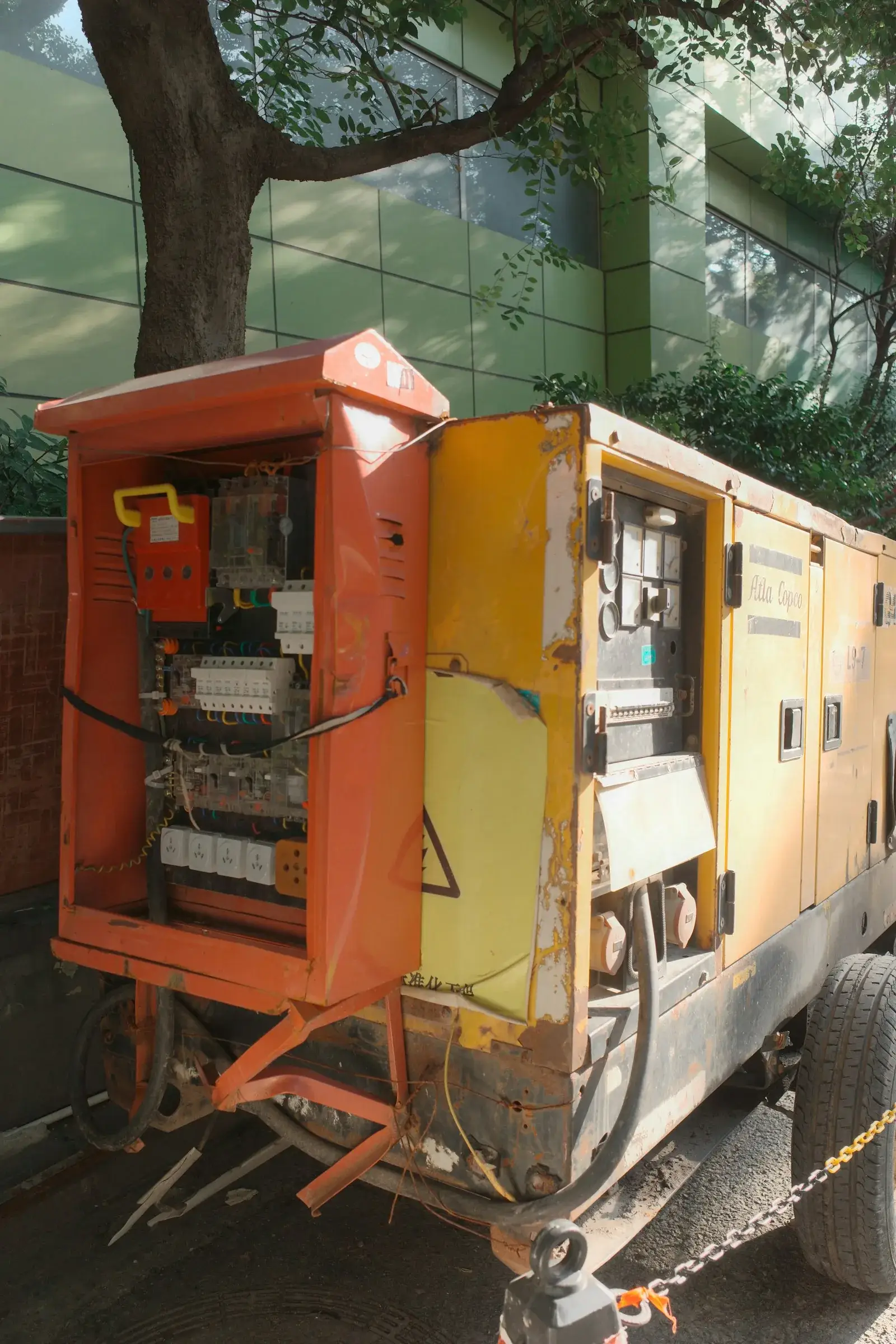
Photovoltaics cuts your bill. Batteries give you margin. The diesel generator is the last-mile insurance: what keeps your warehouse running when a blackout drags on for hours. And unlike the other two, not every business needs it. But those that do, really need it.
This is the honest guide to deciding. No marketing, no “everyone should have one”. Just the right questions.
What it is and what it isn’t
To start clean: a generator is a combustion engine (diesel or gas, normally) coupled to an alternator that produces electricity when the grid fails. Not to be confused with:
- UPS: covers milliseconds to minutes, thanks to internal batteries. Just enough for the generator to start or to shut down a server cleanly.
- Stationary batteries: cover hours, charged with the grid or with solar. Useful for medium outages or to ride out the night without grid.
- Hybrid inverter with backup function: feeds loads directly from the solar plant if there’s sun and the grid is down.
The generator covers the long stretch: outages of several hours, or night outages when the batteries are spent. It’s the only one that can operate indefinitely as long as you have fuel.
The five questions that decide if you need it
Don’t look at models until you’ve answered these five. Honestly.
1. What kind of merchandise or process do you have?
This is the first question. Each sector has very different sensitivity to a power cut:
| Sector | Sensitivity to a long cut |
|---|---|
| Offices, retail | Low — you lose commercial hours and little else |
| Dry logistics warehouse | Low-medium — POS, scanners, management software |
| Industrial cold (food) | High — cold chain loss in 4-8 h |
| Deep freeze | Critical — loss in 12-24 h, huge value |
| Winery in fermentation | Critical — controlled temperature |
| Agro-industry (slaughterhouses, dairies) | Critical — sanitary and economic |
| Data center / servers | Critical — minute by minute |
| Hospital, elderly home | Critical — lives at stake |
| Poultry/pig farm | Critical — forced ventilation |
| CNC production, injection | High — in-progress material destroyed |
| Hotel in season | High — guests and reputation |
| Mechanical workshops | Medium — recoverable in hours |
If your sector is in “critical” or “high” of this table, the question isn’t “do I need a generator?” but “what size and what start time?“.
2. How long can you go without power without losses?
This is the question that changes everything. And the answer must be a concrete figure, not “it depends”:
- Less than 1 minute: you need a UPS with autonomy + generator with fast auto-start. Data center, hospital, continuous processes.
- 1-15 minutes: UPS + standard auto-start generator. Corporate servers, important retail, document management.
- 15 min - 2 hours: batteries or auto-start generator. Commercial cold, workshops with sensitive machinery.
- 2-12 hours: properly sized solar batteries, generator optional if there’s critical cold. Most industrial SMEs.
- More than 12 hours: solar + batteries + generator almost certain. Agro-industry, farms, deep cold, areas with recurring outages.
3. How much does a minute of inactivity cost you?
Do the honest math. Sum:
- Salaries paid for non-production.
- In-progress material that spoils (CNC chains, injection, cold).
- Reset and restart of processes (can take 30-90 min after the lights come back).
- Delayed orders / contractual penalties with clients.
- Reputation and SLA if you have contracts with availability clauses.
If that figure is above €500/hour, it starts to make sense. Above €2,000/hour, it’s almost mandatory.
4. How often does your power go out?
We’re not talking about the historic blackout. We’re talking about:
- Monthly micro-cuts: how many do you have? Ask your electrician or pull the UPS log if you have one.
- Outages over 5 minutes per year: one, two, none?
- Grid zone you’re in: industrial zones at the end of a line usually have more events than consolidated city.
Your distributor publishes the TIEPI (Time of Interruption Equivalent of Installed Power) per province and zone. If your zone’s TIEPI is high (>1 hour/year), a generator amortises on its own.
5. What loads do you have to keep running no matter what?
You don’t need to size the generator for the whole warehouse. Almost never worth it. The right question is: what loads are critical and what’s their consumption when everything else is off?
Typical examples:
- Cold rooms, refrigerated cabinets.
- Servers and network.
- Emergency / security lighting.
- Forced ventilation on farms.
- Water or continuous-process pumps.
- Milking machines / farm equipment.
- 1-2 CNC machines instead of the 8 you have.
That sum of critical loads, multiplied by 1.3 for safety, gives you the minimum kVA of the generator. Many companies are surprised to find that with a 30-60 kVA generator they cover what’s really critical in a warehouse that has 200 kVA contracted.
Diesel or gas: three practical factors
Once the size is decided, the next question:
Diesel
- Pro: easy-to-store fuel, many hours of autonomy with own tank, more reliable cold start.
- Con: noise, emissions, fuel maintenance (diesel ages in storage if not rotated).
- For: most industrial warehouses and agro-industry.
Gas (natural or propane)
- Pro: cleaner, less fuel maintenance, natural gas by grid = infinite autonomy.
- Con: depends on the gas supply (which in some widespread blackouts can also fail), expensive initial installation.
- For: urban areas, hospitals, sites with emissions restrictions.
For the vast majority of companies that come to AUREQIS, diesel is still the sensible format for reliability and cost.
Standby, Prime or Continuous
Three operating modes worth knowing because catalogues mix them up:
- Standby: only starts when the grid drops. The usual for backup. Useful life ~500 h/year.
- Prime: runs regularly as a main source. For zones without stable grid or isolated installations.
- Continuous: works 24/7 at constant load. Heavy industrial.
For normal business backup, what you need is called “standby”. If they offer you “Prime” for that function, they’re overselling.
What decides the total cost (not just the generator)
The generator itself is only half the bill. Also important:
- Automatic transfer switch (ATS / transfer panel): detects grid failure and starts the generator.
- Soundproofing: depends on zone; in industrial it can be minimal, in urban it can multiply the cost.
- Fuel tank: integrated (typically gives 8-12 h) or external (24-72 h).
- Exhaust: chimney with minimum height per regulations.
- Maintenance contract: the generator needs to start monthly under load. Without maintenance, it’ll fail right when you need it.
A 40-80 kVA generator with full installation, ATS, tank and maintenance typically runs €15,000 to €35,000 depending on model and specs. For 100-250 kVA the range rises to €30,000 - €80,000.
Where it fits in a solar + battery strategy
The final question, important because it changes sizing: is it standalone or does it work with solar and batteries?
If you frame it as sole protection (no solar, no batteries):
- You need a large generator that covers all your critical consumption for the entire outage.
- More operating hours = more maintenance, more fuel.
- Start time covered only with UPS.
If you frame it as last layer of a solar + batteries architecture:
- Solar covers the day. Batteries cover the first hours. Generator only starts if the cut runs longer than 4-8 hours.
- Generator can be 30-40 % smaller: only critical load and for less time.
- Fewer use hours = lower fuel consumption, cheaper maintenance.
- In practice, the generator may never start for years and just sit there as insurance.
That second architecture is what we normally recommend. The generator stays the insurance, not the work tool.
In one sentence
A generator isn’t for everyone. But if your merchandise spoils, your process can’t stop or your client penalises downtime, the cheap option is to have one. The expensive option is finding out on a Sunday in August at 4 a.m. that you’ve been six hours without power and eight more to go.
Want to see if it pays off for you, and what size? Request your free study. We do a criticality diagnosis with your sector, your merchandise, your TIEPI and your consumption, and we tell you without trimming whether you need it or not.